The Tzer Island book blog features book reviews written by TChris, the blog's founder.  I hope the blog will help readers discover good books and avoid bad books.  I am a reader, not a book publicist.  This blog does not exist to promote particular books, authors, or publishers.  I therefore do not participate in "virtual book tours" or conduct author interviews.  You will find no contests or giveaways here.

The blog's nonexclusive focus is on literary/mainstream fiction, thriller/crime/spy novels, and science fiction.  While the reviews cover books old and new, in and out of print, the blog does try to direct attention to books that have been recently published.  Reviews of new (or newly reprinted) books generally appear every Monday, Wednesday, and Friday.  Reviews of older books appear on occasional weekends.  Readers are invited and encouraged to comment.  See About Tzer Island for more information about this blog, its categorization of reviews, and its rating system.

Wednesday
Dec262012

Raised from the Ground by José Saramago

First published in Portuguese in 1980; published in translation by Houghton Mifflin Harcourt on December 4, 2012

José Saramago’s death in 2010 was a sad loss for the world of literature, but his novels endure.  It is often difficult to know what to make of a Saramago novel.  He infuses drama with humor so as to make them indistinguishable, relies upon fantasy to illuminate reality, distorts history to help us understand the present.  Saramago merges philosophy with storytelling.  With keen observation, he chronicles moral failings while remaining an extraordinarily forgiving writer.  Unlike nature, which “displays remarkable callousness when creating her various creatures,” Saramago displays compassion and understanding when creating his flawed characters.

Raised from the Ground is the story of the latifundio, the Portuguese landed estates and those who toil upon them. The laborers are the victims of "infinite misfortune, inconsolable grief, both of which lasted from the nineteenth century to the day before yesterday." Plagues, famines, wars, and the cruel overseers of the latifundio are the four horsemen of the apocalypse, the "great evils" that devastate the working poor. The workers spend their lives as if "tethered to a stake," governed by arbitrariness, and in a state of perpetual hunger. Is death the only escape, or is change possible? Fighting for a minimum wage and an eight hour day may seem futile, but futility is a way of life in the latifundio. It is the need to fight for change that compels the narrator to proclaim: "we are not men if we do not raise ourselves up from the ground."

With their meager possessions loaded onto a donkey cart, the shoemaker Domingos Mau-Tempo and his wife (Sara da Conceição) and son (João) make their way to their new home in São Cristóvão, the first of several relocations Domingos will impose upon his family. Domingos' miserable story (briefly interrupted in 1910 by the arrival of the Portuguese Republic and the end of the monarchy) segues into Sara's sad story and eventually becomes João's. Circumstances turn João into an unwitting labor leader, or at least he is mistaken for one; his support of a strike becomes the defining event of his life. The meandering story eventually introduces João's son António, who is drafted into the army despite his illiteracy, his daughter Gracinda, who wants to marry João's friend despite her poverty, and his granddaughter Maria, who shares his blue eyes. In 1974, the Carnation Revolution overthrows Portugal's dictatorship, an event that brings the living and dead together in celebration, a fitting end to a powerful story.

The novel's run-on sentences, assembled from words seemingly poured from buckets, flow with a rhythm that is uniquely Saramago's. Dialog is buried haphazardly in the text, always in keeping with the rhythm of the narrative, never set off by quotation marks, and while it's usually easy to understand who is speaking, some readers will be put off by the unconventional style. Although the narrator's identity is neither clear nor consistent, the narrator's chatty editorial voice is always present. As if conversing with a friend, the narrator will mention a town and say "you probably know the place." The narrator sometimes professes not to understand the mysteries of life that he is relating, sometimes says "let's see how things turn out." He gives the reader information that, he says, won't contribute to an understanding of the story, but will let us "know each other better, as the gospels urge us to do." He reminds us that "the seemingly unimportant and the seemingly important form part of the same narrative," and all of it, taken together, is "as good a way as any to explain the latifundio." He suggests that people who might take a different view of the latifundio "clearly don't know much about life." All of this is vintage Saramago: tongue-in-cheek, playful commentary masking profound wisdom shaped by boundless compassion.

Compassionate wisdom is abundant in this haunting story. Saramago reveals the dignity and tribulations of the working poor and the indifferent cruelty of those who exploit them. He explores poverty and charity and the great equalizing force of death. He bemoans wars that tax and kill the poor while benefitting the rich. He ridicules the labeling of striking farm workers as terrorists and exposes the true terrorists: the government agents who have the power to brand those who speak for the powerless as "dangerous elements." He describes the torture of a man from the standpoint of an ant that, unlike the torturers, has a conscience. He lampoons priests who pray for the landowners and lecture the poor. Most importantly, amidst all the agony and suffering that his novel documents, he wryly acknowledges that "life has its good points too." Travel and beauty and sex and birth bring joy and renewal, even if only for a moment. Yet if "each day brings some hope with its sorrow ... then the sorrow will never end and the hope will only ever be just that and nothing more."

Saramago's matter-of-fact presentation of the absurd is filled with deadpan wit and goofy digressions. He treats the reader to hilarious descriptions of peasantry sex ("they huff and puff, they're not exactly subtle"), a political rally ("Where do I go to take a piss?"), middle age ("if this is the prime of life, then allow me to weep"), and the revolution ("what kind of name is junta for a government, there must be some mistake"). António's tall hunting stories, including his technique for catching a hare with pepper and a newspaper, are reason enough to read the book. Yet even the funniest stories are in some sense allegorical. They illuminate life in the latifundio, which isn't much different for rabbits and men.

HIGHLY RECOMMENDED

Monday
Dec242012

Merry Christmas!

Sunday
Dec232012

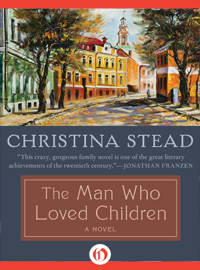
The Man Who Loved Children by Christina Stead

First published in Australia in 1940; published digitally by Open Road Media on October 23, 2012 

Henny, a character in The Man Who Loved Children, condemns every popular novel she reads as "silly rot, muck, and a lot of hooey." Perhaps Christina Stead wrote The Man Who Loved Children as an antidote to the popular novel. Its strength is the depth of its characters, yet the two most significant characters are so disagreeable that the book will never warm a reader's heart. By writing a novel with no likable characters and little plot, Stead shunned the formula for popularity. She nonetheless managed to craft a book worth reading, although you might cringe a few times before reaching the end and sigh with relief when you've finally conquered it.

To an outsider, living with the Pollitt family would be a maddening experience. Reading about the Pollitt family, on the other hand, is like watching a volcano that is about to erupt and destroy a village. The sense of impending horror is so strong I could only manage it in small doses. The parents are fascinating but repellent, a husband and wife who, wielding words as weapons, seem destined not just to destroy each other, but to bring about the metaphorical (and perhaps literal) annihilation of their entire family.

Sam and Henny deserve each other. Their blistering arguments make George and Martha of Who's Afraid of Virginia Woolf? seem like Romeo and Juliet. Henny is a harridan, a "brackish well of hate." She is the queen of all drama queens. When she isn't promising to poison herself, she's threatening to beat all the children to death. She regards life "as a series of piracies of all powers." She is a compulsive and secretive borrower and spender. Although she hates Sam, Henny revels in the knowledge that "the dread power of wifehood" compels him to stay with her.

Sam is Henny's superficially cheerful opposite -- optimistic, full of love for his children -- yet at his core, there is little to distinguish Sam from Henny. Sam regards his marriage as years spent in "mental rot and spiritual death." He complains that he only wants to be understood, yet Henny understands him perfectly. Sam is, she says, "the great I-Am." Sam fancies himself the perfect husband and father while continually berating Henny and calling his daughter Louie a "great fat lump." Sam claims to be in love with his fellow man, yet he advocates eugenics and rules his own house with a tyrannical intolerance of individuality.

In addition to Louie (eleven when the novel begins, fourteen when it ends), who was born to Sam's first wife before she died, Sam and Henny have five children (Henny gives birth to another during the course of the novel). Sam believes his "great fitness is to be a leader of children." He thinks he is "teaching them to be good men and women" while "a woman was always twisting them, snatching them away from him." Sam doesn't want his children to grow up. He insists that Louie should stay with him forever. As the family descends into poverty, Sam barely notices. He wants more children.

Sam speaks a language that is all his own, a mixture of mispronunciations, rhymes, and gibberish that outsiders would regard as a foreign tongue. The language bonds his children to Sam while isolating them from neighbors and friends.

Sam's relationship with Louie is a little creepy. He is fascinated by "the mystery of female adolescence of which, in his prim boyhood, he had been ignorant." At the same time, he views himself as her guardian against impure influences. Sam wants to shelter Louie from the debauchery of dancing lessons and fine dresses. He views it as his duty to protect all his children from "filthy thoughts." The reader wonders whether Sam is trying to shelter himself from those thoughts, particularly with regard to Louie.

Louie is a moody girl who labors to constrain her inner beast. Although Sam forbids the reading of novels, Louie spends every free moment with books. She writes plays and sonnets, sometimes in languages that she invents. Louie is the only child who can see her father for the windbag he is. When the other children revel in Sam's silly rhymes about the neighbors, she lodges futile objections to his rudeness. Louie is so desperate for real love that she befriends wretched neighbors and begins writing love poetry to her teacher, Miss Aiden. Her other passion is for her friend Clare, who joins her "in days of mad fervor about nothing at all."

The novel follows the Pollits through setbacks and tribulations. Unfortunate characters litter the novel, including Sam's batty sisters and destitute in-laws. Sam's job takes him to Malaysia; his return ten months later is greeted with the birth of yet another child. Sam eventually loses his job, leading to the family's gradual decline into poverty. To the extent that the novel has a plot, it revolves around Henny's response to the family's financial decline, and the reactions of Sam and Louie to Henny.

I did not quickly adapt to the rambling, meandering, quirky style in which The Man Who Loved Children is written, although I eventually came to appreciate it. I did not ever warm to the sullen, broken, hypocritical characters who populate the novel, although I eventually came to admire the skill with which they are constructed, and to feel some sympathy for Louie. Despite its inevitability, the novel's denouement is both shocking and horrifying. For its unforgettable characters and often startling prose, I am glad I read The Man Who Loved Children, but I wouldn't want to read it again.

RECOMMENDED

Friday
Dec212012

A White Arrest by Ken Bruen

First published in the UK in 1998; published digitally by MysteriousPress.com/Open Road Media on December 18, 2012

Although A White Arrest could be characterized as a police procedural, there is little police work and almost no detection on display. It might be better to think of A White Arrest as a crime novel. A White Arrest features plenty of crime, at least half of it committed by the police. Fundamentally, though, A White Arrest is a stark examination of three characters, all cops: Roberts, Brant, and Falls.

Neither Chief Inspector Roberts nor Detective Sergeant Brant are exemplary law enforcement officers. Roberts and Brant are likely to get sacked if they don't pull off a white arrest, the sort of legendary, career-making, front page arrest that guarantees lifetime employment. Their best chance would be to catch a serial killer known as The Umpire, who has been murdering cricket players. Another possibility would be to arrest the members of the E crew, a four person gang dedicated to killing dealers and stealing their drugs.

While Ken Bruen gives the reader a peek into the disturbed minds of The Umpire and the leader of the E crew, Bruen gives most of his attention to the cops, particularly Brant, whose mind is as unsettled as those of the criminals he's half-heartedly trying to catch. Brant is the jerk of all jerks, the kind of cop who takes bribes, steals money, abuses suspects, and stiffs the pizza delivery guy. When he isn't sexually harassing female officers, Brant is getting liquor on credit from the off-licence shop (a debt he never intends to pay), watching The Simpsons, and reading Ed McBain novels. He also fantasizes about shagging Roberts' wife, Fiona. Roberts certainly isn't getting satisfaction from Fiona, who (egged on by her friend Penny) has it on with a boytoy she hires at a club that caters to women of "a certain age."

Susan Falls is a female constable who joined the force to escape from a troubled family, only to find that the police are themselves a troubled family. Falls yearns for love. Sadly for her, she's in a Ken Bruen novel, where love is a scarce commodity.

As you'd expect from Bruen, A White Arrest is riddled with quotations from crime novels and movies (although the Umpire tends to quote Shakespeare, always a good source when it comes to murder). The novel's brisk pace and penetrating prose make it a quick read. Don't expect much in the way of plot, and don't expect the police to do anything that might actually solve a crime. Roberts and Brant don't always catch the bad guy, and when they do manage to make an arrest, it's more a function of luck than effort. A White Arrest isn't a novel for someone who wants a traditional police procedural filled with hard-working, likable cops. For readers who are intrigued by flawed characters living gritty lives, A White Arrest is -- like all of Bruen's novels -- meaty entertainment.

RECOMMENDED

Wednesday
Dec192012

Nexus by Ramez Naam

Published by Angry Robot on December 18, 2012 

What does it mean to be posthuman? It means with the right software, you can fight like Bruce Lee and perform like Peter North. It means your mind can network with those of other posthumans. It means your intelligence is vastly superior to that of mere humans. But can humans and posthumans coexist? Does the rise of the posthuman necessitate the death of the human? The questions posed in Nexus aren't new, but they have rarely been explored in such an entertaining fashion.

Although it is swallowed like a drug, Nexus is a nano-structure that creates an interface between the brain and computer software. It acts as a networking platform and an operating system. It creates the potential for one Nexus user to control another. Nexus is both a regulated drug and a prohibited technology. In short, it is illegal. Should it be?

Kaden Lane is one of a select group of people who, in addition to researching Nexus, is permanently infected with it. He thinks Nexus should be available to everyone, although he's worried that some users (and some governments) will abuse it. Samantha Cataranes works for a division of Homeland Security that responds to emerging risks. She views Nexus as a risk. She could lock up Kaden but she'd prefer to enlist his help for a more critical mission: determining whether the Chinese are using Nexus to create remote controlled assassins. If Kaden doesn't want to spend the rest of his life in prison, his task is to cozy up to Su-Yong Shu, suspected of being the primary architect of China's neurotech program. She is also suspected of being posthuman.

Kaden is a well-rounded, believable character. He isn't the only one. Samantha is Kaden's backup on the mission, a role that troubles her because she will need to use Nexus. The thought frightens her because she knows she enjoys Nexus despite her moral opposition to it, adding a layer of complexity to her character. Watson Cole, on the other hand, has no such qualms. Nexus gave him the gift of empathy. Once a battle-hardened marine, Cole is now a disciple of peace. Cole has a mission of his own: to make Nexus available to everyone, so they can experience the same transformation. While Cole's transformation occurs before the novel begins, Kaden and Samantha are continually questioning their beliefs, reevaluating their loyalties, evolving in response to new experiences and discoveries. They are fascinating characters.

Nexus gains intellectual heft from a contemporary philosophical debate that Ramez Naam projects into the future. Drugs and technology can be abused or they can be used responsibly. Should government prevent abuse by prohibiting the possession of anything new that might be abused, or should government tolerate a degree of abuse to promote individual freedom and societal advances? By developing and potentially releasing the means to develop posthuman life, is Kaden "threatening to make real humans obsolete," as Samantha argues, or is he empowering people with options they've never had before? This is the sort of debate that science fiction does so well -- anticipating ethical dilemmas of the future and, in so doing, shining a light on ethical dilemmas of the present.

Nexus tackles other issues as well, including the acquiescence of scientists in the suppression of science (scientists who protest put their research grants at risk) and the tendency of American foreign policy to disrupt or destroy the lives of innocent foreigners. Other things I liked about Nexus: the imaginative surveillance technology; the eagerness (as always) of the government to become just as bad as the bad guys it condemns; the grounding of repressive legislation in fear that the government instills, and the willingness of Americans to surrender their rights in response to those fears; the layers of intrigue; the characters' ever-changing perspectives of right and wrong; the true and surprising nature of Su-Yong Shu; the incorporation of Buddhist philosophy; the use of a virally infected religious cult and a Waco-like incident to explain Samantha's background; the extrapolation of the "war on drugs" and "war on terror" to a "war on science"; the paradox that sharing minds might promote individuality rather than "groupthink"; the battle between the government, as it attempts to suppress information released virally, and net users who labor to defeat the government's efforts.

And then there's the writing. Neem writes clear prose that, if not particularly lush, is well suited to the kind of story he tells. Action scenes are vivid and more imaginative than most thriller writers manage. Once the background is established, the pace is furious. A touch of melodrama in the ending is easy for forgive, as is a needlessly preachy epilog.

Nexus is intense, exciting, and thought-provoking. It's also fun.

RECOMMENDED